
Last updated October 31, 2026
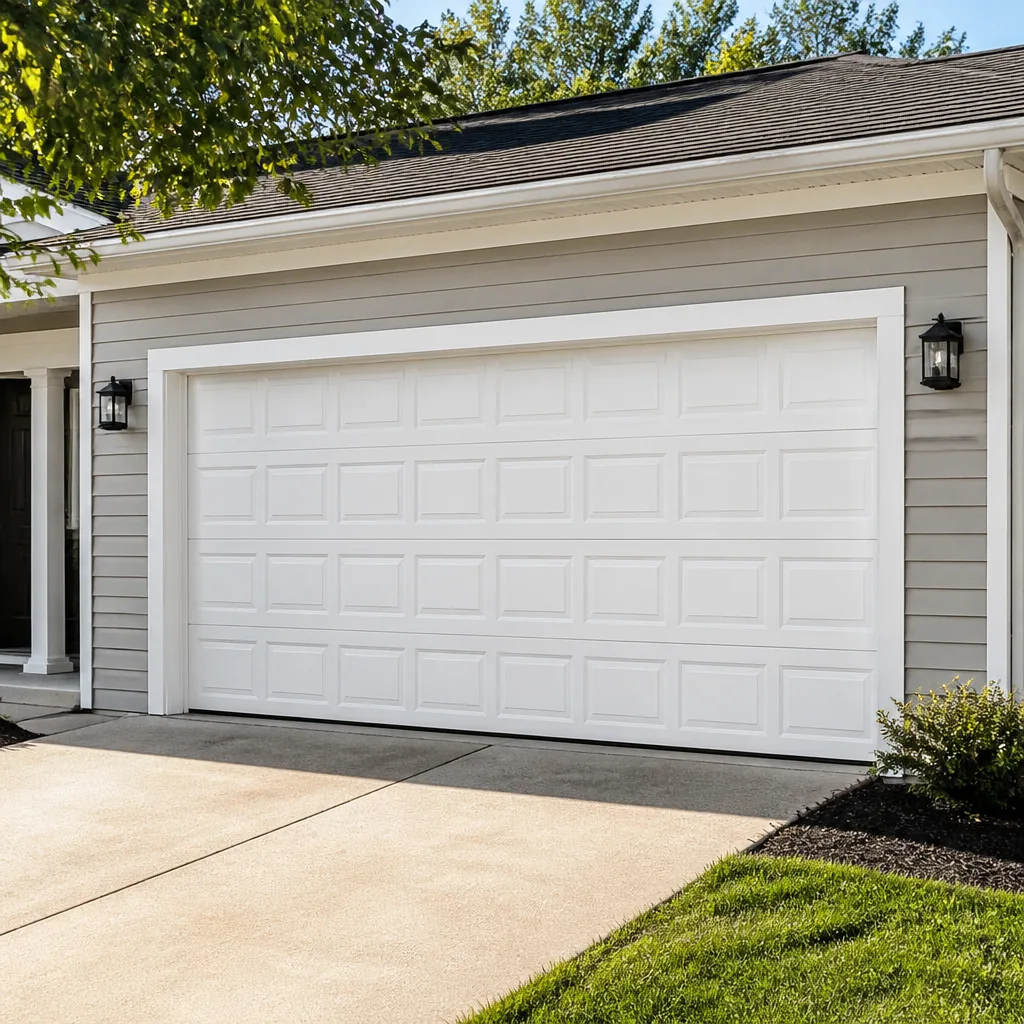 Raised-panel steel
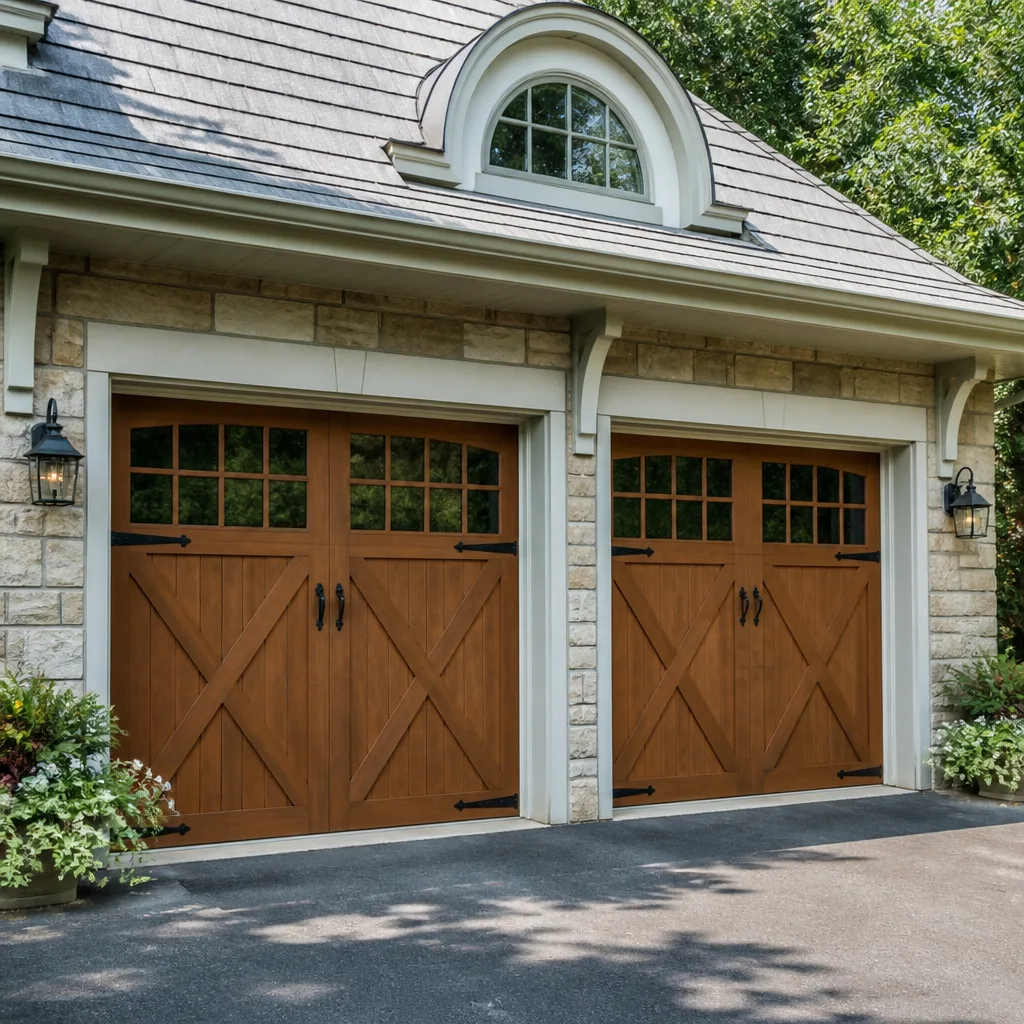 Carriage house
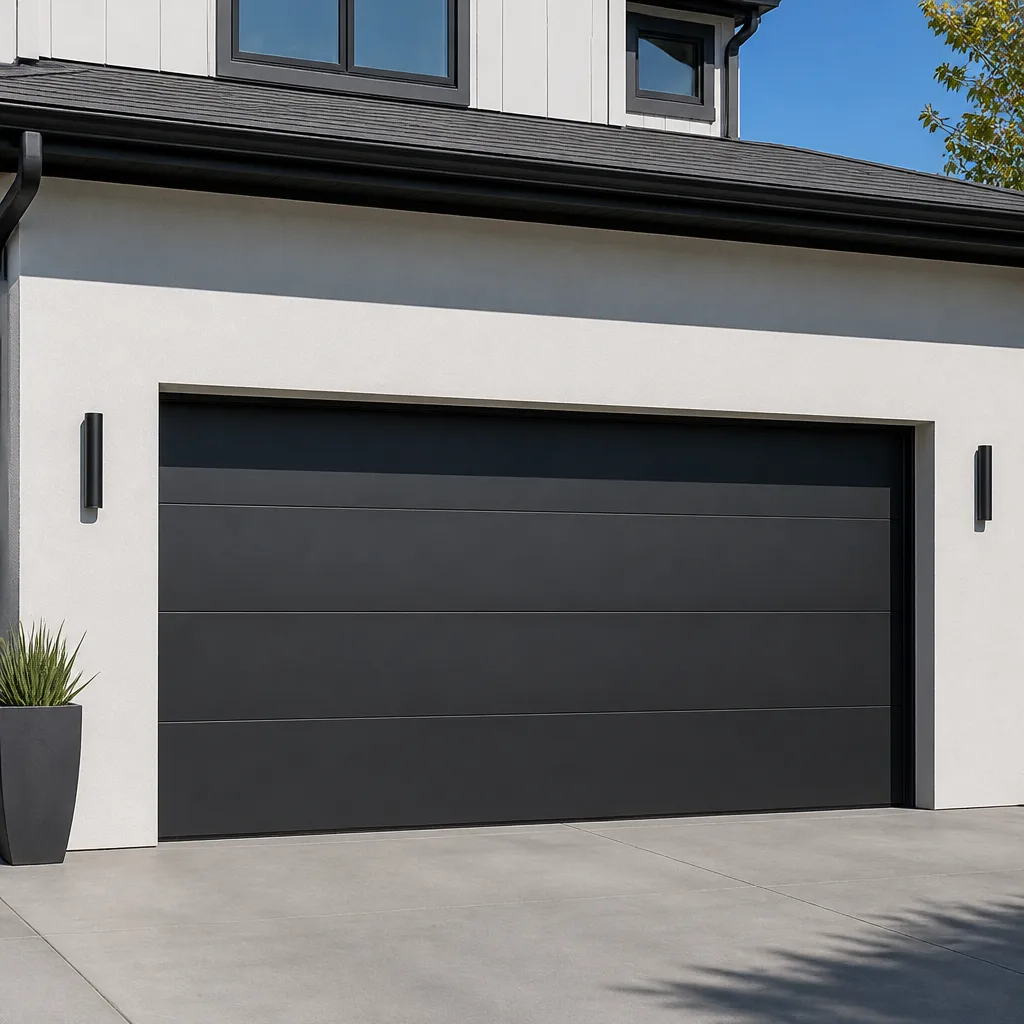 Modern flush
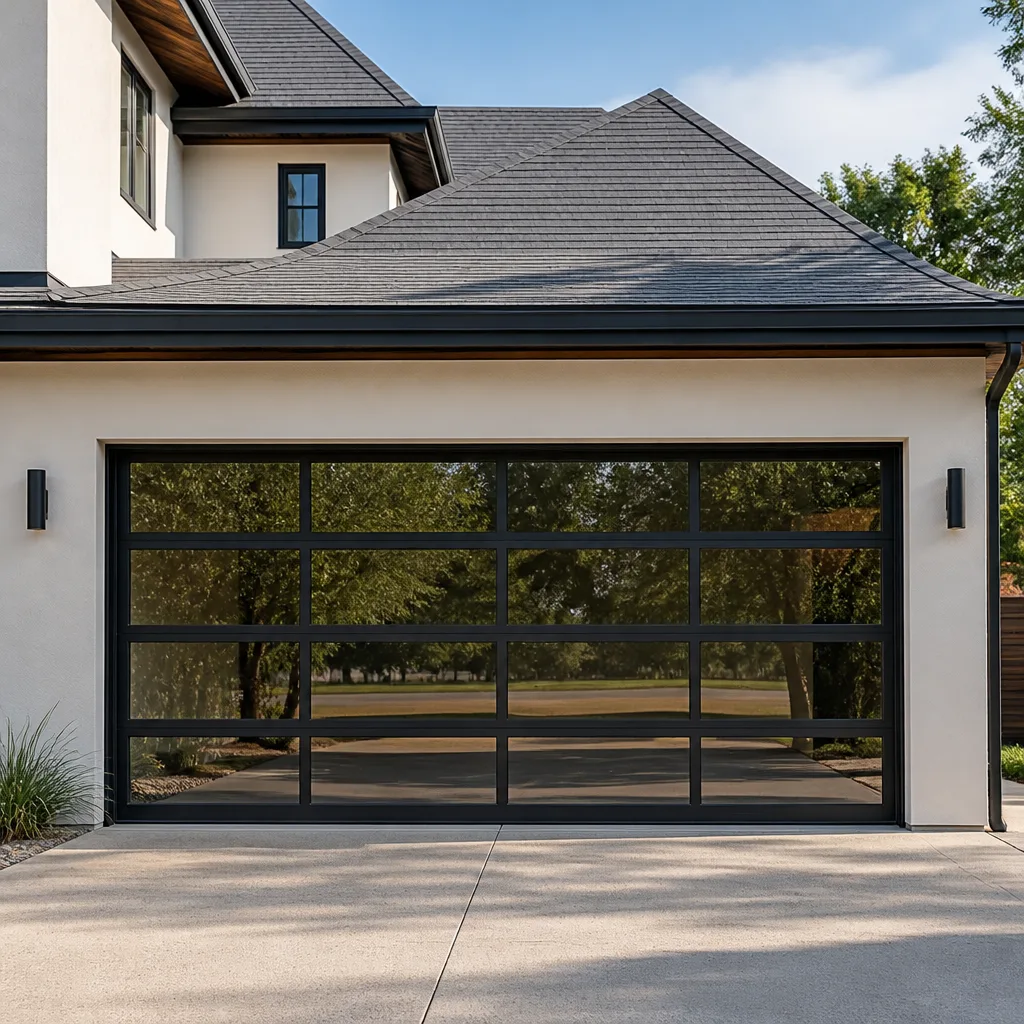 Full-view glass
 LiftMaster openers
 Chamberlain openers
Full 25-point door and opener safety check with every visit - springs, cables, rollers, tracks, and your LiftMaster or Chamberlain opener included
You get a price before we start. It does not change when the truck arrives.
Get your free estimateHow to Hire a Garage Door Contractor in Los Angeles: A Step-by-Step Guide
Here’s a fact most Los Angeles homeowners discover too late: the state of California does not require garage door contractors to hold a specialty license. A general contractor with a C-10 or B classification can legally quote your spring replacement, which means the person standing in your driveway may have zero documented training on the high-tension systems that hold a 150-pound door above your car. This guide gives you a vetting framework that exposes the difference between a genuine specialist and a generalist with a van, before anyone touches your door, and you can find more guides & resources on our blog.
Quick Answer
To hire a garage door contractor in Los Angeles, verify their California contractor license on the CSLB database, confirm they have documented experience with your specific door and opener brand, require an in-person inspection and itemized written quote before any work begins, and check that the quote separates parts, labor, and hardware line-by-line. Get three quotes for spring or cable work, since price variance for identical jobs across Los Angeles regularly exceeds 60%.
Styles & brands we work with
Table of Contents
- Step 1: Verify the License Before Anyone Touches Your Door
- Step 2: Ask the Five Questions That Separate Specialists from Replacement-Pushers
- Step 3: Read the Quote Line by Line
- Step 4: Spot Los Angeles Market Red Flags
- Step 5: Why Three Quotes Matter for Spring and Cable Work
- What Makes Los Angeles Garage Doors Different
- The Pre-Hire Checklist
Step 1: Verify the License Before Anyone Touches Your Door
California contractor licensing law is specific about who can legally work on your garage door, and the answer surprises most homeowners. Garage door installation and repair falls under general building or electrical classifications, not a dedicated garage door license. This means a licensed C-10 electrical contractor, a licensed B general building contractor, or in some cases a C-61/D-28 door and gate contractor can all legally quote the job. What matters is that the person quoting actually holds a valid license, and that the license is active, not suspended or expired.
Here’s how to verify any contractor in under two minutes:
- Go to the California Contractors State License Board (CSLB) website at cslb.ca.gov.
- Click “Check a License” and enter the contractor’s name, business name, or license number.
- Confirm the license status reads “Active” and the expiration date is in the future.
- Check the classification. For garage door work, a B, C-10, or C-61/D-28 is legally permitted. A C-36 plumbing license or C-27 landscaping license is not.
- Look at the “Workers’ Compensation” field. If the contractor has employees and no workers’ comp coverage, you could be liable if someone gets hurt on your property.
- Review any disclosures. The CSLB lists judgments, arbitration awards, and pending disciplinary actions right on the license page.
We’ve seen homeowners in Los Angeles call us after a spring replacement failed two weeks later, only to discover the person they hired was working under someone else’s license or had no license at all. The CSLB database takes two minutes to check, and it should be the first gate any contractor passes. At Onyx Garage Door Service home, our technicians work under proper licensing and insurance, and we’re comfortable with homeowners verifying us the same way we’d recommend they verify anyone.
Step 2: Ask the Five Questions That Separate Specialists from Replacement-Pushers
The fastest way to expose a contractor who wants to sell you a new door instead of fixing the one you own is to ask about the brand you already have, as covered in our Choosing the Right Garage Door Brand: A Buyer’s Guide for Los Angeles. A specialist who genuinely works across multiple manufacturers will answer with specifics. A replacement-pusher will deflect toward pricing a new unit.
Here are the five questions, and what the answers reveal:
- “What experience do you have with my specific brand?” If you own a Raynor door with a LiftMaster opener, say so. A multi-brand specialist will tell you what they know about Raynor’s panel construction or LiftMaster’s logic board history. A generalist will say “all doors are basically the same.” They’re not.
- “Will you diagnose before you quote a replacement?” A technician who quotes a full door replacement over the phone, without inspecting the existing system, is selling, not diagnosing. A specialist wants to see the door first.
- “Do you stock parts for my brand, or will you need to order them?” For common failures on major brands, a well-equipped contractor carries the parts. If the answer is always “we’ll need to order that,” they may not actually work on your system regularly.
- “What’s the most common failure you see on this model?” This tests depth of knowledge. For a Genie opener, a specialist might mention the travel module or the RPM sensor. For a Chamberlain, it might be the logic board or the gear and sprocket. A vague answer signals shallow experience.
- “Can you service the door and the opener in the same visit?” Many homeowners in Los Angeles have a Chamberlain opener mounted on a Clopay door. If the contractor only handles one half of that system, you’ll be coordinating two vendors for what should be one call. Onyx Garage Door Service is built around the idea that one company handles the door panel, the hardware, and the opener system, because that’s how the systems actually fail: together.
In our experience, the contractors who push replacement hardest are the ones least equipped to diagnose. When a technician knows your brand’s parts and failure points, repair becomes a conversation about cost and timeline, not a sales pitch. We work on your brand, not just our preferred one.
Step 3: Read the Quote Line by Line
An itemized quote is the single best indicator of how a contractor operates. Vague line items hide markups and signal that the contractor is either inexperienced or preparing to change the number once work starts. Here’s what a legitimate garage door quote in Los Angeles should include, line by line:
- Parts: Named specifically. Not “spring hardware” but “pair of 218 x 2 x 24.5 torsion springs” or “one LiftMaster 8500W wall-mount opener.” Brand names should appear where they matter.
- Labor: A flat rate or hourly rate with an estimated number of hours. For spring replacement, flat rate is standard. If it’s hourly, ask for a cap.
- Hardware: This should list what’s included: bearings, cables, rollers, brackets. If the line just says “hardware” with a round number, ask what specifically is being replaced.
- Disposal: Who removes the old parts and door? Is there a haul-away fee? Los Angeles landfills charge for construction debris, and some contractors pass that cost through as a surprise line item.
- Warranty: What’s covered, for how long, and whether it’s parts only or parts and labor. If the warranty section is blank, ask why.
- Total, fixed: The price quoted should be the price paid, with any variables (like a second spring that turns out to be worn) called out in advance as a possible add-on with its own price.
The red-flag line items are the vague ones: “miscellaneous hardware,” “additional labor as needed,” or a percentage-based “project management fee” on a two-hour repair. These are the lines that let a quote grow after the work starts. A reputable contractor in Los Angeles quotes a fixed price and agrees to it before any tools come off the truck. The price you agree to before work starts is the price you pay, period.
Step 4: Spot Los Angeles Market Red Flags
Los Angeles is a high-volume market for garage door work, and that volume attracts contractors who optimize for speed and ticket size over quality. We’ve heard the same stories from homeowners in neighborhoods across the city, from Encino to Echo Park to El Segundo. Here are the red flags specific to how this market operates:
- No physical address, just a phone number and a Google listing. A contractor who can’t show you a shop or a yard where they store parts and vehicles is often a one-person operation running entirely on subcontractors. Not always, but often enough to warrant a second look.
- Unmarked vehicles. A technician who shows up in a personal car with no business identification, no uniform, and tools in the trunk is not operating like a business that stands behind its work.
- Quotes given sight-unseen over the phone. A spring replacement quote given without seeing the door is a guess. Torsion springs come in different wire sizes, lengths, and inside diameters. A contractor who quotes before inspecting is either padding the price or planning to change it later.
- Pressure to sign today. “This price is only good if you sign right now” is a sales tactic, not a service practice. A legitimate contractor’s pricing doesn’t expire at midnight.
- No written estimate, just a verbal number. In California, a home improvement contract over $500 must be in writing and include specific disclosures. If the contractor won’t put the number on paper, walk away.
None of these alone are disqualifying, but two or more together form a pattern. In Los Angeles, where demand is constant and a contractor can fill their schedule without ever doing great work, the red flags are how you filter out the volume chasers.
Step 5: Why Three Quotes Matter for Spring and Cable Work
For spring replacement, cable replacement, and other high-wear mechanical repairs, we consistently tell Los Angeles homeowners to get three quotes. Here’s why: the price variance for the identical job across this market regularly exceeds 60%. We’ve seen homeowners quoted $229 and $540 for the same pair of torsion springs on the same model of Amarr door. The difference wasn’t parts cost. It was contractor overhead, urgency pricing, and in some cases, a willingness to charge whatever the market would bear.
Three quotes do two things. First, they anchor the fair market range for your specific door and neighborhood. Second, they expose outliers in both directions. A quote dramatically lower than the others usually means cheaper parts (lower cycle-rated springs) or a technician who will find “additional issues” once the door is apart. A quote dramatically higher usually means you’re paying for a brand name or an advertising budget, not better work.
That said, don’t let price be the only variable. We tell homeowners this: price tells you what the market charges. The questions in Step 2 tell you what the contractor knows. The goal is the intersection of a fair price and a technician who can name the failure mode before they touch the door. From a broken spring to a full new installation, one company, one call, and a price you agreed to in advance.
What Makes Los Angeles Garage Doors Different
Garage doors in Los Angeles live a different life than doors in Phoenix or Minneapolis. The coastal moisture from marine layer mornings means rust on cables and rollers happens faster in Santa Monica than it does in Pasadena, even though they’re 30 miles apart. The temperature swings between the Valley’s 110-degree summers and 40-degree winter nights cause metal fatigue cycles that shorten spring life. And the salt air near Venice, Playa del Rey, and San Pedro accelerates corrosion on everything from torsion hardware to opener rails.
What this means practically:
- Spring life in Los Angeles averages 7 to 10 years, but a door two blocks from the beach may need springs at 5 years. A contractor who only quotes “standard” spring cycles isn’t accounting for your microclimate.
- Rust is the enemy here, not cold. In a city with almost no freezing weather, the failure modes are corrosion-related, and the fix is often upgraded galvanized hardware rather than just a new part of the same type.
- Many Los Angeles homes are older, built in the 1950s through 1980s, with doors that have been re-fitted multiple times. The original door may be long gone, replaced by a Clopay or Amarr unit that was itself installed by a contractor who’s since retired. That’s why brand-specific knowledge matters: a technician who recognizes a 1990s Raynor track system doesn’t waste time trying to fit a modern bracket to it.
The point is this: hiring in Los Angeles means hiring someone who understands the specific conditions your door faces. A contractor who’s only ever worked in the Inland Empire may not anticipate what marine layer moisture does to a Genie opener’s circuit board over five years. Local experience is a real variable, not a marketing line.
The Pre-Hire Checklist
By the time you’re ready to make a decision, you should have worked through every item on this list. Copy it, print it, or just keep it open on your phone while you take quotes.
- License verified on CSLB. Active status, appropriate classification, workers’ comp in place.
- In-person inspection completed. No quote over the phone for repairs. Period.
- Brand-specific questions answered. The contractor knew your Chamberlain, Raynor, LiftMaster, or Genie system by name and could speak to its specific failure modes.
- Written, itemized quote received. Parts, labor, hardware, disposal, warranty, and a fixed total.
- Quote line items reviewed. No vague “miscellaneous” entries. No percentage-based fees on a repair job.
- Two additional quotes obtained for spring, cable, or other mechanical repair work.
- Red flags cleared. Marked vehicle, physical address, no high-pressure sales tactics.
If you’ve checked all seven, you’re hiring with more rigor than 95% of Los Angeles homeowners. That’s the difference between a garage door that opens quietly for the next decade and a spring that lets go at 6:45 a.m. on a Monday.
Common Mistakes to Avoid
- Hiring based on the first Google ad you see. Paid placement doesn’t equal competency. The top ad in Los Angeles for “garage door repair” is often whoever spends the most on clicks, not whoever diagnoses best. Always check the license and ask the brand questions regardless of how you found them.
- Accepting a phone quote for spring work. Torsion springs are sized by wire gauge, coil diameter, and length. Nobody can quote that accurately without seeing the spring. A phone quote is either a placeholder or a trap.
- Replacing a door when a repair would do. Some failures genuinely warrant replacement: a collapsed panel on a 30-year-old door, structural rot in the frame. But a worn roller, a noisy opener, or a frayed cable is a repair. A contractor who skips straight to replacement is solving their problem, not yours.
- Signing a contract that doesn’t state the total price. In California, the contract must include the total cost, the scope of work, and a schedule. If the document in front of you doesn’t have a fixed number, it’s not a contract, it’s an open checkbook.
- Ignoring the warranty section. A one-year parts warranty on a spring that’s rated for 10,000 cycles is a mismatch. Ask what happens if the part fails inside the warranty window, and who pays the labor to install the replacement.
- Paying in full before the job starts. California law limits the deposit on home improvement work to 10% or $1,000, whichever is less. Anyone asking for half up front is outside the law.
See the difference
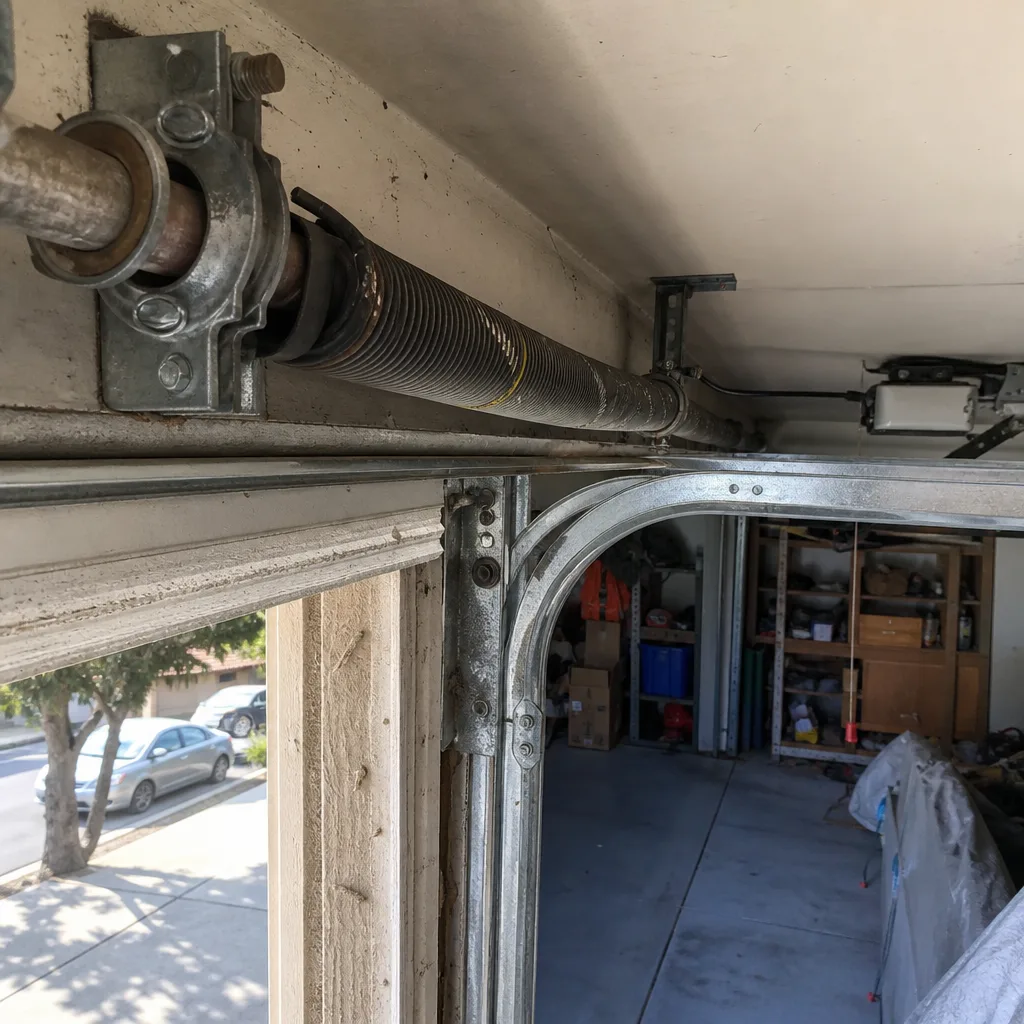 Before
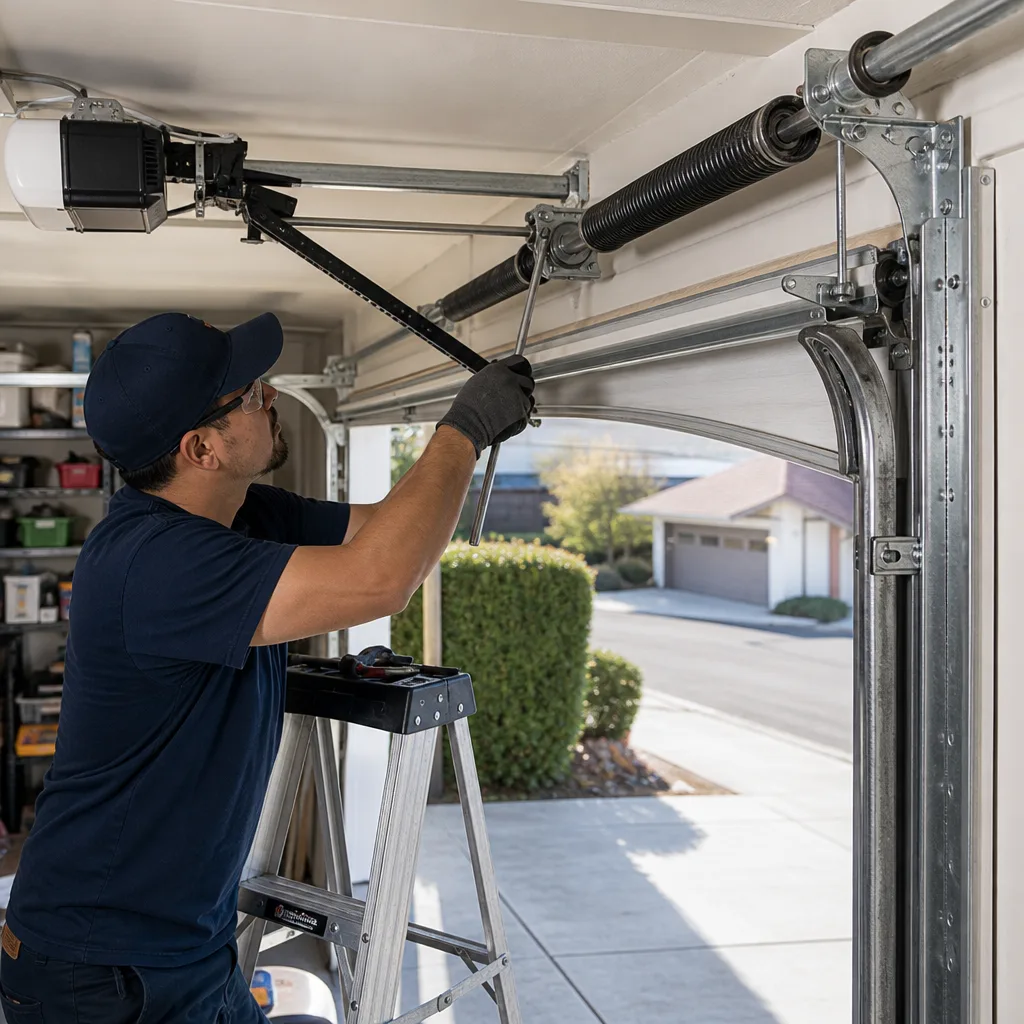 After
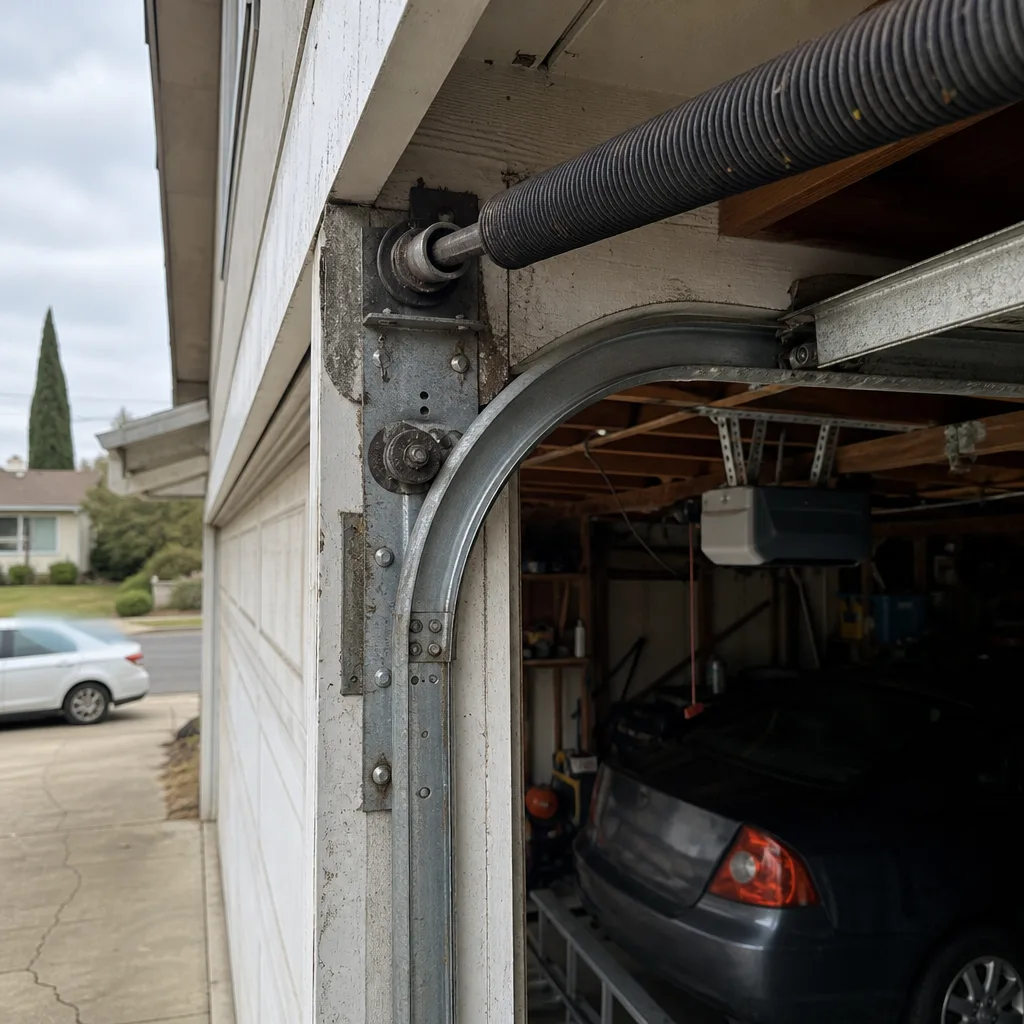 Before
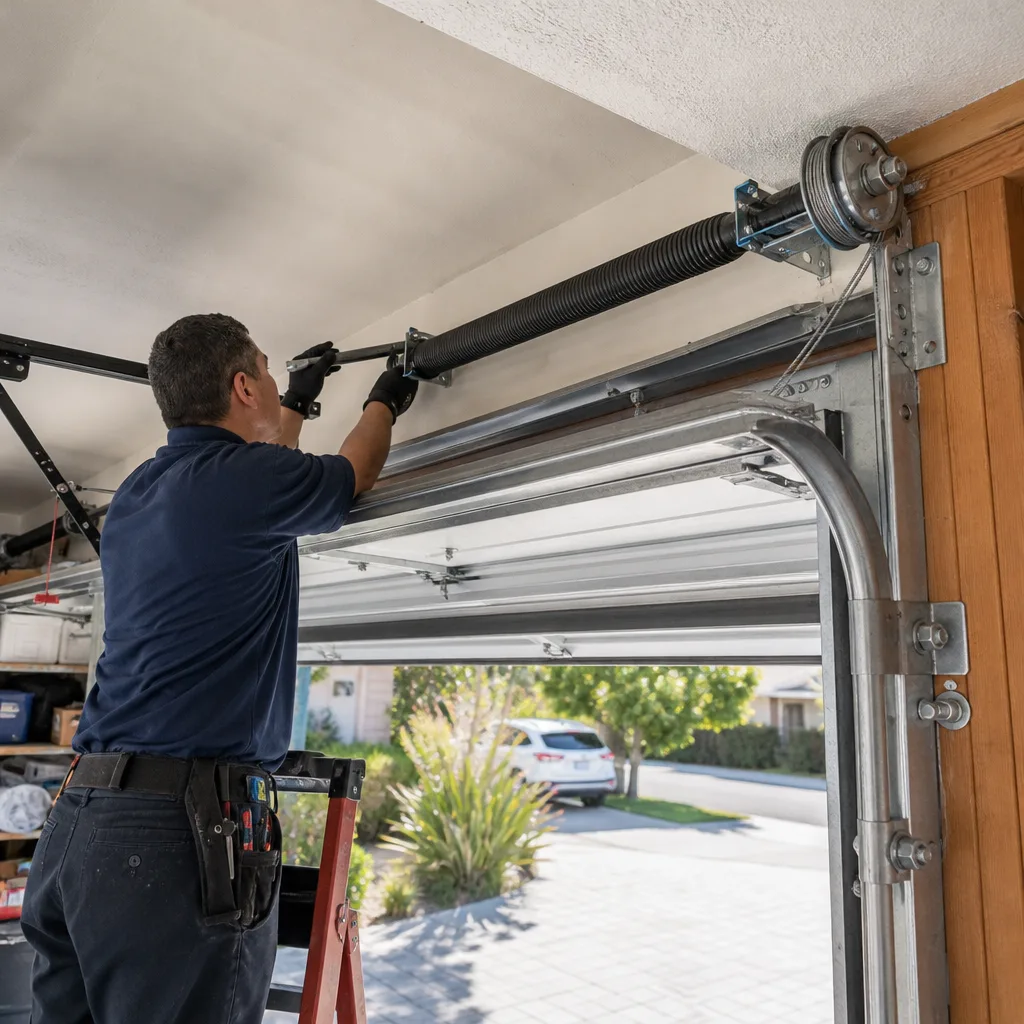 After
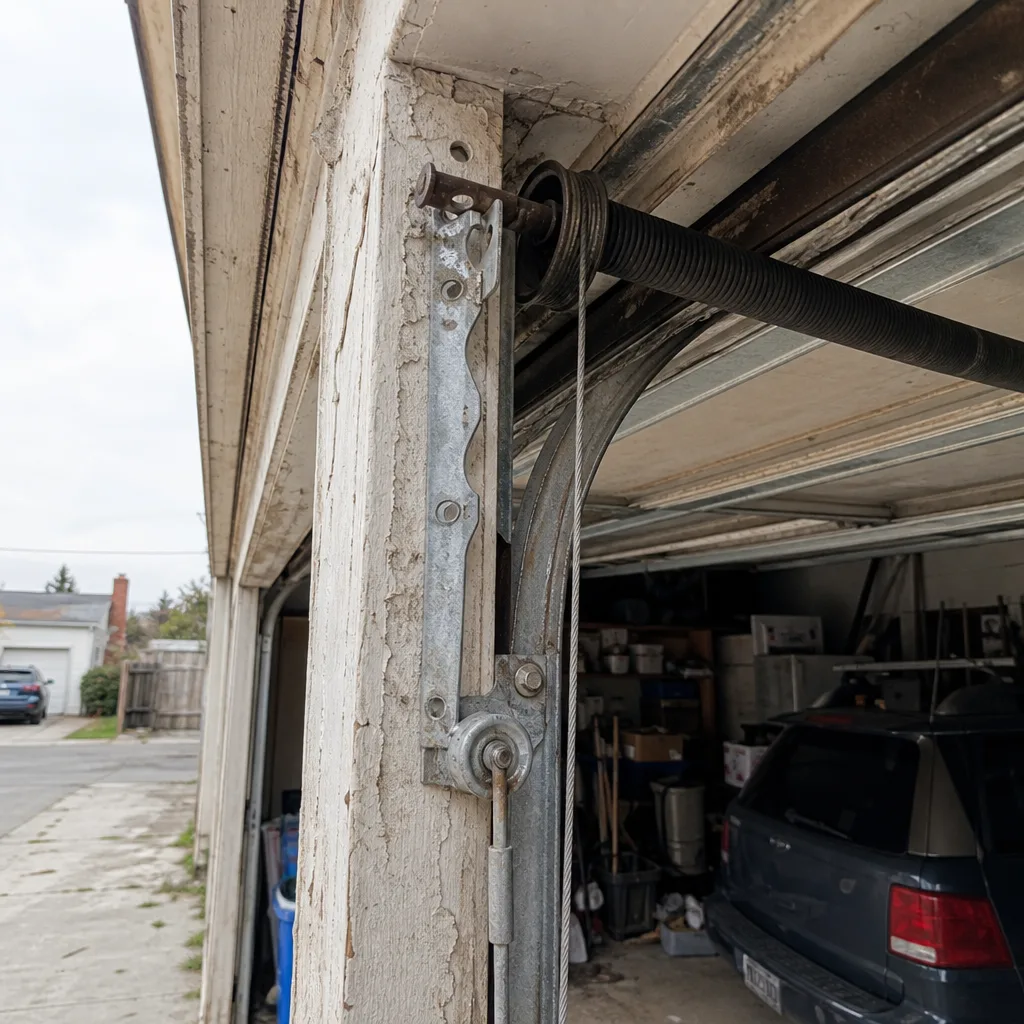 Before
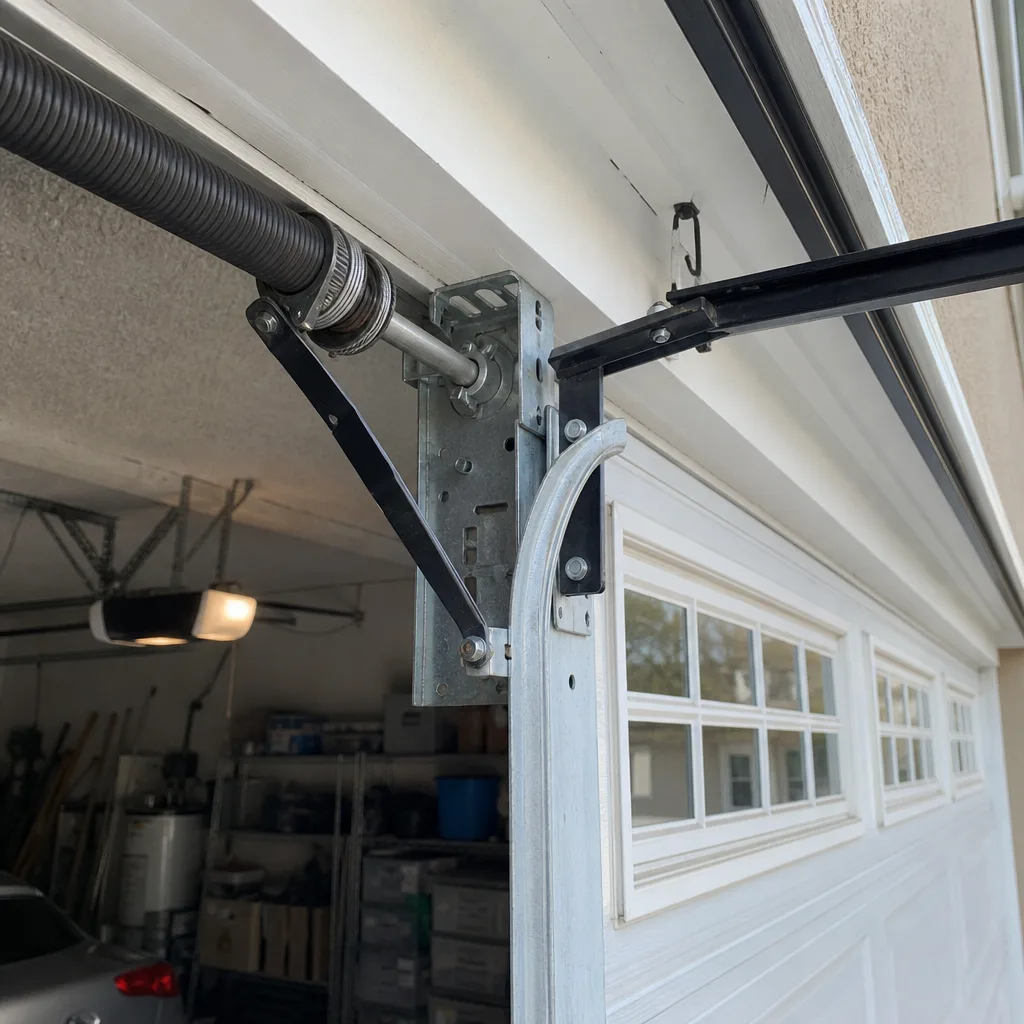 After
When to Call a Professional
There are garage door issues that should never be a DIY project, and the chief one is anything involving torsion springs. The spring system on a typical Los Angeles garage door holds hundreds of pounds of tension, and a spring that releases unexpectedly can cause serious injury or death. Cables under tension are the same. If your door has a snapped spring, a frayed cable, a door that’s off its track, or an opener that’s sparking or smoking, don’t touch it. Leave the door where it is, unplug the opener if you can reach the cord safely, and call a contractor who handles these systems professionally. Precision matters when your garage door is the largest moving part of your home. Onyx Garage Door Service offers free estimates in Los Angeles, call (877) 588-8251.
Frequently Asked Questions
Garage door spring repair in Los Angeles typically costs $180 to $340 for a pair of torsion springs, including labor, with prices higher for doors near the coast where corrosion-resistant parts are recommended, and higher still for oversized or unusually tall doors. Always get three quotes for spring work, since Los Angeles price variance for identical jobs regularly exceeds 60%. Call (877) 588-8251 for an exact quote after an in-person inspection, and remember the price you agree to before work starts should be the price you pay.
Most direct garage door replacements in Los Angeles do not require a permit, as they fall under routine maintenance like-for-like, but structural changes such as widening the opening, adding a new header, or converting a carport to a garage do require building permits through the Los Angeles Department of Building and Safety. Always ask your contractor whether your specific project triggers permit requirements, and be wary of any contractor who suggests skipping permits on structural work.
A handyman in California cannot legally perform garage door spring replacement if the project exceeds $500 in labor and materials combined, because the state caps handyman work at that threshold, and spring replacement on most doors in Los Angeles exceeds it. Above $500, the person must hold a valid contractor license through the CSLB, and you should verify that license before any work begins.
A straightforward garage door installation in Los Angeles typically takes one full day, including removal of the old door, installation of the new panels and track, mounting of the opener if included, and haul-away of debris. Custom sizes, older homes with non-standard framing, or jobs requiring new structural supports can add a second day, and your contractor should give you a realistic timeline during the on-site estimate.
A repair-focused company diagnoses and fixes existing systems, working across brands and failure modes, while a pure installer measures and hangs new doors, often representing a single manufacturer’s product line, and the value of hiring a company that does both is that a technician who repairs Clopay doors daily also knows how to install a Clopay door correctly, as detailed in The Complete Garage Door Repair Guide for Los Angeles Homeowners. Onyx Garage Door Service handles repair, opener repair, and installation under one roof, covering LiftMaster, Chamberlain, Genie, Clopay, Amarr, Wayne Dalton, Craftsman, and Raynor systems.
The price should not increase once a contractor has inspected your door and given you a written quote, and a fixed-price quote is the standard for reputable garage door work in Los Angeles, but the contractor should also disclose in writing any potential add-ons discovered during the job, like a second spring that’s near failure, with a price attached to each before work proceeds. Repairs done right the first time, no upsell pressure. Call (877) 588-8251 for a free estimate and a written price before any work starts.
The Bottom Line
Hiring a garage door contractor in Los Angeles is not about finding the cheapest quote or the biggest ad budget. It’s about verifying a license, asking questions that reveal whether the technician actually knows your brand, and demanding a written, itemized quote with a fixed price before any work begins. The city’s high-volume market means the difference between a specialist and a generalist is often hidden behind identical-looking websites and the same Google ad copy. Do the two-minute license check, ask the five brand questions, get three quotes for spring and cable work, and you’ll hire with more diligence than almost anyone on your block. For homeowners in Los Angeles who want a technician who already knows their LiftMaster, Chamberlain, Genie, Raynor, or Clopay system, Garage Door Repair in South Gate, Garage Door Opener Repair in South Gate, and Garage Door Installation in South Gate are all services we provide, with free estimates at (877) 588-8251.
Written by the team at Onyx Garage Door Service, serving Los Angeles since 2014.